
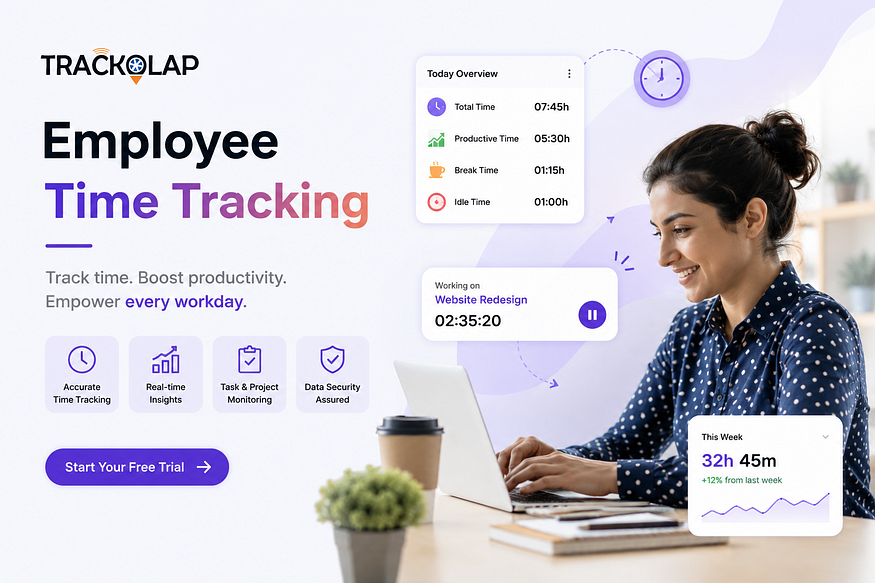
Are you making critical business decisions without full visibility? In day-to-day operations, many organizations rely on assumptions rather than real data, which increases the risk of inefficiencies and missed opportunities. If organizations rely on assumptions about how their staff work, they often miss what is really happening on the ground. Employee time tracking software helps organisations to get more clarity and an accurate view of daily operations. It helps businesses use resources more efficiently and provides the data needed to make better decisions.
Understanding the Role of Time Tracking Software
Today, time tracking is more than logging hours. It is also recording how people worked. By providing visibility into how employees spend their time across multiple tasks, projects, and responsibilities, time tracking solutions can now provide answers to the following key questions:
- Where was my time expended?
- What tasks require me to apply the greatest amount of effort?
- Did my efforts provide the expected outcomes?
These tools have evolved from simply providing data for reporting purposes to serving as a tool to support business decision-making. When combined with employee productivity software, they provide a complete view of overall performance and operational efficiency.
Core Capabilities That Enable Smarter Business Decisions
The real value of time tracking is in its ability to translate to the overall success of a business. For example:
Real-time visibility into work activity
When your employee productivity software is processed in real time, you can see how your employees are engaged in their work.
Task-level time distribution insights
Time allocation by task helps identify time-wasting activities and focus on the most important tasks.
Automated reporting and analytics
Rather than manual collation, businesses get reports with insights on trends and areas for improvement.
Seamless integration with business systems
Accurate connections to payroll, operations, and reporting integrations enable seamless integration across all processes.
Support for remote and field teams
With location-based and mobile time tracking capabilities, managing a geographically dispersed employee workforce is simplified.
How Businesses Use Time Tracking Data to Drive Decisions
- Workforce Productivity Optimization
Time tracking helps uncover hidden productivity gaps in daily work. It shows where employees spend time on repetitive or low-value tasks. This allows managers to improve workflows and increase output without adding extra workload.
2. Resource Allocation & Workforce Planning
Supervisors can make smart staffing decisions once they know the distribution of workload across their workforce. Decision-making will be made based on:
- Actual capacity of the workforce to accomplish work
- Complexity of the tasks being performed
- Availability of team members
It reduces the employee burden and improves workforce planning with an efficient outcome.
3. Cost Control & Profitability Analysis
The amount of time spent working on a task can be directly related to the operational cost of that task. By evaluating the amount of time being invested in a project relative to the project’s return on investment, businesses can:
- More accurately estimate the project costs.
- Identify low-value-added projects and the amount of time being consumed by each.
- Forecast financial performance more precisely.
4. Performance Evaluation & Accountability
Measurable performance indicators can be established through time recording. Instead of relying only on personal judgment, managers can now assess employee performance using real data. They can evaluate patterns like consistency, efficiency, and task completion more accurately. It creates a more honest, more open, and transparent task evaluation approach.
Many times, the negative impact of inefficiencies is not evident until they have produced negative results. The use of time tracking information will help illustrate delays, bottlenecks, and redundant tasks, and provide companies with the opportunity to:
- Eliminate unnecessary steps
- Create streamlined processes
- Increase the speed of execution
How to Evaluate the Business Impact of Time Tracking Solutions
When selecting a time tracking solution, choosing one that provides actionable insights is the most effective use of a time tracking tool versus one that only provides basic data.
The ease of use is an essential consideration in selecting a time tracking solution. If a time tracking solution is simple to implement and to use, this increases the level of employee engagement in using the solution. It also helps to ensure that quality information is captured through the employee’s use of the solution. Employee productivity software delivers capabilities for both time tracking and comprehensive management of the workforce through improved efficiencies.
Why Businesses Choose TrackOlap for Smarter Decision-Making
For today’s businesses, time-tracking functions alone are not sufficient; they need a tracking system that generates useful insights through the use of their day-to-day work-related data.
The traditional way of doing business frequently results in interruptions or delays because of miscommunication, lack of accessibility, and a variety of other issues. It creates difficulties for enterprises as it limits their ability to respond quickly and with confidence. However, an integrated system provides companies with the opportunity to make smarter and faster decisions.
Key reasons businesses prefer TrackOlap include:
- Centralized visibility into all operational areas — You can get all employee activity, task, and performance data in one place, making it possible to see how everything is related.
- Real-time decision support — You can look at live data when an operational problem occurs.
- Integrated task and tracking system- It is possible to link your daily activities with your overall business plan without having to switch between different systems or applications.
- Actionable reporting and insights — TrackOlap turns raw data into easily comprehensible intelligence for you to utilize in your decision-making process.
- Scalability for growing teams — As the size of your team and the level of complexity of your operations grow, TrackOlap can easily adapt.
By implementing an integrated approach to tracking, task management, and analytics, TrackOlap supports organizations to move from simple monitoring to the execution of strategic plans, enabling leaders to make more reliable and accurate decisions while having control of overall productivity and performance.
Conclusion
In today’s business environment, decision-makers need to act quickly and accurately. Therefore, incomplete information can limit growth. Time tracking software allows businesses to see clearly how their teams are working, thereby allowing them to identify areas for improvement.
Businesses can use the tracking of their employees’ daily activities and turn them into structured insights, which will help them improve overall productivity, optimize resources, and develop long-term success for their business.
Organisations can transition from simple time management to a data-driven strategic plan for workforce management by leveraging more refined tools such as TrackOlap.

Frequently Asked Questions
1. How can time tracking data influence long-term business strategy?
Understanding productivity trends, resource allocation, and operational efficiency would enable businesses to develop long-term strategies that evolve as needed over time.
2. Can time tracking reveal hidden inefficiencies in workflows?
Yes, time tracking can highlight inefficiencies, such as delays in projects or repetitive tasks, which may not be evident without the use of more sophisticated means of analysis, such as manual observation.
3. How often should businesses analyze time tracking reports?
Regular weekly reviews of time and attendance data will support operational decisions, while monthly reviews will support strategic decision-making.
4. Does time tracking work equally well for creative and non-creative roles?
Yes, but the way in which time is interpreted will differ between the two types of roles. Focus for creative roles will be on the quality of the output and on time patterns as opposed to a strict number of hours worked.
5. How can businesses prevent misuse or inaccurate time logging?
By using automated tracking devices and establishing clear guidelines regarding the proper use of employee time-tracking software, companies can increase the reliability and accuracy of time-tracking data collected.
6. What challenges do companies face when implementing time tracking software?
Some of the most common challenges businesses encounter during the implementation of employee time tracking software include employee resistance, a lack of clear direction for the usage of the software, and poor utilization of the data collected.
7. How does time tracking support scalability in growing businesses?
It offers insights into resource requirements and workload patterns, allowing for efficient scaling.




0 Comments