
"Employee productivity software helps businesses track, analyse and optimize how work is performed by identifying patterns in time usage, task distribution, and collaboration. It reveals hidden inefficiencies and improves overall team performance."
Work no longer has a limited scope in terms of its task, tool, or place. Employees team up, interact, and operate concurrently across several platforms in dynamic work contexts. Consequently, the need to comprehend the way in which work is actually going on has never been more significant.
Organizations are paying more attention to the way productivity is created, not only by its results, but by the daily work in teams and processes.
Here, employee productivity software comes in. It offers organized access to work behavior and assists organizations in comprehending the productivity flow that traverses across various levels of execution. It not only concentrates on the outcomes but also highlights patterns that affect performance. Analysing these patterns, businesses can construct a better view of how teams are functioning at the moment.
The Evolving Need for Work Visibility
Modern organizations have distributed workforces, online technologies, and shifting priorities. In these conditions, leaders need a better perspective of how work flows through planning to implementation.
A variety of companies already utilize such systems as employee time tracking software to facilitate the organization of working hours and task scheduling. In addition to this, increased productivity scope enables organizations to have a more comprehensive perspective of the distribution of efforts in projects.
Today, it is not only the work that is recorded, but the connection between various activities and the overall performance is understood.
It has transformed visibility into work behavior into a critical aspect of modern workforce management.
Understanding Work Patterns in Modern Teams
Organizations have their own work patterns. These trends indicate the collaboration of teams, their priorities, and workflow.
There are some common patterns, such as:
Diversity in task involvement among roles.
Variations in the time of focus with workload structure.
Variations in the intensity of collaboration in nature.
Movement of workflow between planning and execution processes.
These trends are not issues. They are natural features of the functioning of work in the real world. But having a clear understanding of them enables organizations to maximize performance in a better way. These trends become more visible with organized data from employee productivity software.
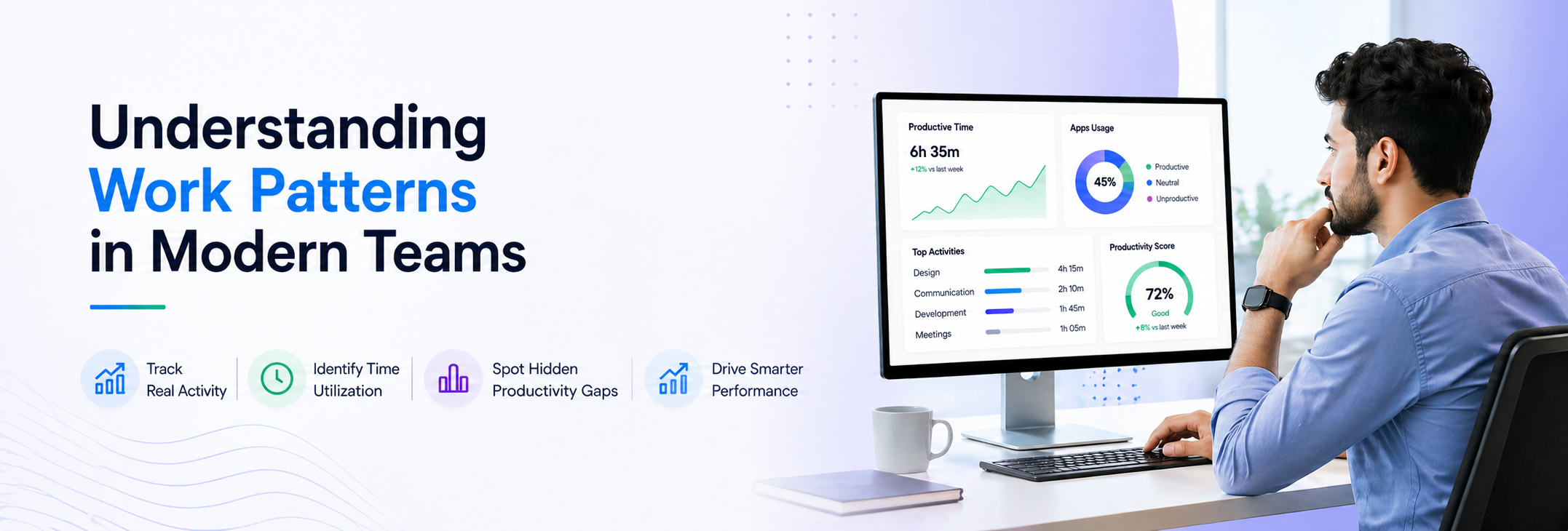
How Employee Productivity Software Captures Work Behavior
Employee productivity software gives a framework for how work is performed in the day. It delivers awareness to the work activity in the moment and converts it into valuable insights for managers and teams.
It generally assists organizations to comprehend:
The allocation of time in various activities and projects.
Employee interaction with tools and applications in the working process.
The way work evolves through the process of initiation to completion.
The changing focus during the working day.
It generates a closer comprehension of work performance. Employee productivity software is used to assist organizations in viewing the entire journey of work, rather than isolated outputs, as productivity.
Key Work Patterns Identified Through Productivity Insights
Work Distribution Patterns
There is normally a varying workload among teams. Certain tasks are inherently more responsible, and others are specialized or assistance-oriented.
Employee productivity software insights enable organizations to visualise the distribution of work, which can be easier to align with capacity and skill sets.
Focus and Engagement Patterns
Different activities need various concentrations. There is work that involves intense focus and necessitates regular teamwork. Through examining engagement trends, organizations can gain a better insight into how employees organize their day and how various work types affect the productivity flow.
Activity Alignment Patterns
Workers usually have a number of tasks to attend to during the day. Details of how these activities are related to priorities assist organizations in ensuring that effort is put into meaningful results.
Employee productivity software gives insight into the way tasks relate to the larger goals, and assists in aligning teams.
Workflow Progress Patterns
Work does not exist in a vacuum. It flows through processes like planning, implementation, reviewing, and completion. The stages are involved in efficiency.
Mapping of workflow progress enables organizations to know how smoothly the work moves through the stages and where there are chances to enhance a better coordination process.
The Role of Employee Productivity Software in Modern Workplaces
Structured visibility is becoming more significant as organizations expand and implement more flexible work models.
This is aided by employee productivity software, which provides a clear perspective of how work is done at the team and the functional level. It helps organizations:
Understand daily work behavior in real time
Improve alignment between tasks and priorities
Strengthen collaboration across distributed teams
Support more informed workforce planning
Together with such tools as employee time tracking software, it helps to form a more comprehensive picture of the organization and the implementation of work.
It also helps organizations in developing a more formalized and clear productivity approach.
Final Thoughts
The work in modern businesses is impacted by a variety of activities linked to workflows and decisions. It is crucial to learn how these factors are combined to enhance efficiency and performance.
Employee productivity software helps organizations understand these work patterns through structured insights. It shows how work progresses, how time is allocated, and how teams collaborate.
It does not just emphasize results but allows further insight into the way productivity is constructed during the working day.
At TrackOlap, the strategy aims to assist firms in enhancing the visibility of the workforce, enhancing operational alignment, and aiding in making better decisions in the teams.
TrackOlap helps businesses uncover hidden productivity patterns, track employee performance in real time, and improve operational efficiency with AI-powered insights. Book a free demo to see how your team actually works.
FAQs
1. Why do employees appear busy but productivity still feels low?
Multitasking among employees is common, and without focused work, production decreases even though there is always visible work.
2. How can managers identify where actual work time is getting lost?
Productivity software is used to monitor idle time, switching of tasks, and delays to clearly demonstrate the concealed time wastes.
3. Why do traditional reports fail to show real team performance?
Conventional reports lack real-time behavior and only highlight the output, but not the actual working patterns.
4. What kind of hidden inefficiencies affect team productivity the most?
Lack of balance in workloads, change of contexts, lack of priorities, and workflow delays pose significant invisible productivity inefficiencies.
5. How does better visibility into work patterns improve decision-making?
The transparent nature assists managers in distributing tasks in a better way, minimizes delays, and enhances the overall efficiency of the workforce




0 Comments